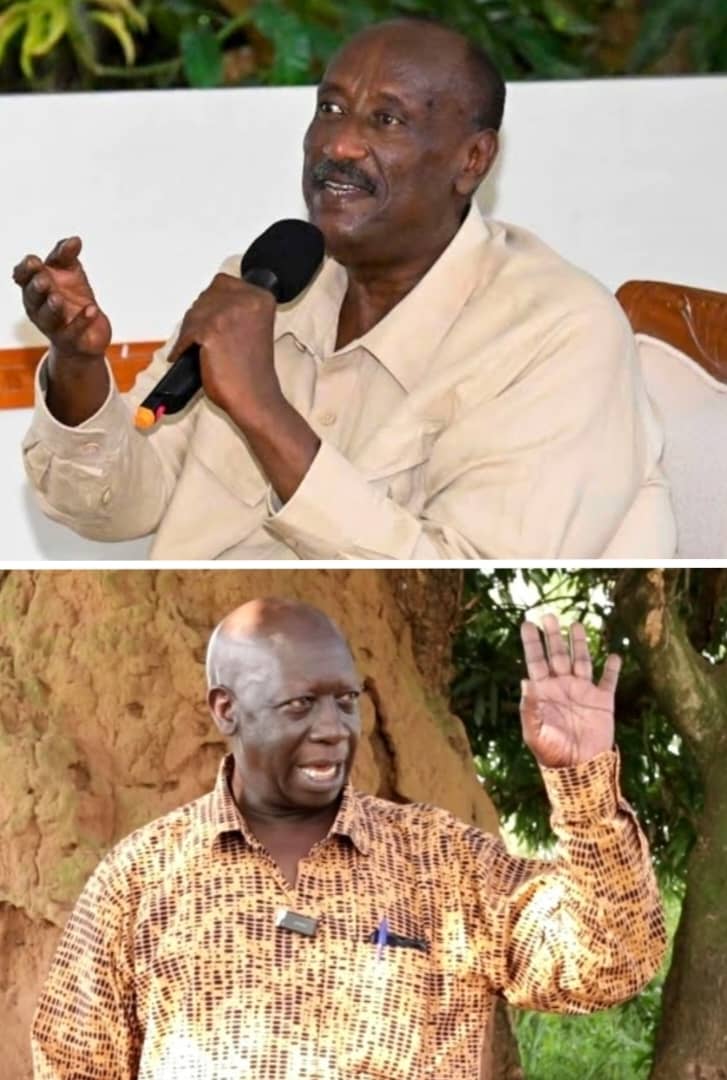
 Gen. Saleh Advocates Consociational Model to Resolve Uganda’s Enduring Political Impasse.
 𝐇𝐀𝐔𝐍𝐓𝐈𝐍𝐆 𝐀𝐔𝐃𝐈𝐎 𝐂𝐀𝐏𝐓𝐔𝐑𝐄𝐒 𝐏𝐈𝐋𝐎𝐓𝐒\' 𝐅𝐈𝐍𝐀𝐋 𝐌𝐎𝐌𝐄𝐍𝐓𝐒 𝐀𝐒 𝟗 𝐃𝐈𝐄 𝐈𝐍 𝐅𝐋𝐎𝐑𝐈𝐃𝐀 𝐏𝐋𝐀𝐍𝐄 𝐂𝐑𝐀𝐒𝐇
 African Head Of State Charged With Murdering His Wife After She Refused To Sign Divorce Papers
 OFWONO OPONDO: ECWERU IS A FADING POLITICIAN, HAS NO MORAL AUTHORITY TO FIGHT GEN. ELWELU
 Fik Fameica, Makerere Guild President Gracious Kadondi Exchange Words During Freshers Ball
Gen. Saleh Advocates Consociational Model to Resolve Uganda’s Enduring Political Impasse.

By Musa Rwamigoye
Gen. Salim Saleh has called for a broad-based, inclusive national power-sharing framework to address Uganda’s protracted political polarization, disclosing that he is engaged in discreet consultations with opposition stalwart Dr. Kizza Besigye.
The initiative, he said, seeks to insulate successive and younger generations from inheriting the unresolved ideological and political contestations rooted in the country’s liberation-era leadership.
Speaking to Chairpersons of Parliamentary Committees at Kapeeka, Nakaseke District, on Thursday, Gen. Saleh underscored the need for a critical retrospection of the political schisms that fragmented the National Resistance Movement’s original broad-based coalition following the 1986 liberation.
The retired general, who also serves as Chief Coordinator of Operation Wealth Creation (OWC), said he is undertaking a comprehensive historical interrogation of the origins of these divisions as part of a deliberate effort to forge what he termed a common national outlook and consensus.
“We are carefully examining what needs to be done for you people of 35, 45, 50, 55, so that you don’t inherit our generational quarrels,” Saleh told the legislators. “That’s what we are trying very hard, and I hope God will help us to achieve that.”
Saleh’s remarks come as he champions a proposed Consociational Democracy Agreement, conceptualized in collaboration with historian Prof. Ogenga Otunnu, as a framework for addressing entrenched political exclusion, sectarianism and conflict through structured cooperation, consensus-building and inclusive power-sharing among competing political formations.
The proposal envisages an inclusive, five-year national dialogue and transition process bringing together political parties, civil society, religious and cultural institutions, with far-reaching reforms intended to restore public confidence, strengthen democratic institutions and enhance electoral integrity and credibility.
Saleh urged the legislators to critically study the framework, arguing that President Museveni has a well-documented history of political accommodation, having previously incorporated rival political actors and former insurgents through negotiated political settlements.
“I think you need to study what we are proposing now,” he said, referencing President Museveni’s legacy of political compromise and broad-based governance.
HOW THE NRM’S FOUNDING COALITION COLLAPSED.
Gen Saleh traced the genesis of Uganda’s current political polarization to the collapse of the broad-based governance model that underpinned the early National Resistance Movement (NRM) administration.
According to Saleh, upon capturing state power in January 1986, the NRM did not govern alone but constituted an inclusive, all-encompassing administration drawn largely from outside its core ranks.
“If you examine the composition of the first Cabinet in 1986, the NRM itself was barely represented. It was dominated by the Democratic Party,” he noted.
Gen. Saleh argued that this initial political accommodation ensured national harmony and legitimacy. However, the subsequent withdrawal of the Democratic Party and other coalition partners from the broad-based arrangement created a structural vacuum and precipitated political discord.
“Once the DP walked away, chaos was injected into the political structure. What had been a period of remarkable harmony was lost,” he said.
He contended that the disintegration of that founding coalition laid the foundation for the adversarial, winner-takes-all politics that has since defined Uganda’s multiparty dispensation.
The NRM initially pursued a broad-based model of governance that incorporated eminent figures from rival political formations, notably the Democratic Party, before fundamental fissures emerged over the trajectory of political reforms and the country’s future political direction.
Saleh traced his ideological divergence with Dr. Besigye to the late 1990s, a period when the two comrades began to articulate competing diagnoses of Uganda’s most pressing national challenges.
He recalled that while Dr. Besigye raised early concerns over governance and the country’s political trajectory, he himself considered entrenched poverty and socio-economic transformation as the more urgent and existential threat to national stability.
“Mine was for fighting poverty. I was saying that poverty is going to be our main challenge, but Dr. Besigye was saying politics is going to be our big challenge,” Saleh said.
“So we separated at that moment, and then what followed? You all know.”
Dr. Besigye subsequently emerged as one of President Museveni’s most formidable and enduring political opponents, contesting against him in four successive presidential elections and becoming the face of the opposition’s push for political reform.
GEN. SALEH SEEKS COMMON GROUND WITH Dr. BESIGYE.
Gen. Saleh disclosed that his recent intervention regarding Dr. Besigye’s medical welfare had inadvertently reopened channels of communication between them after years of political estrangement.
He noted that the opportunity arose after the Chief of Defence Forces, Gen. Muhoozi Kainerugaba, publicly indicated on August 25 that Saleh had been entrusted with managing Besigye’s situation.
According to Saleh, the renewed engagement transcends personal reconciliation and is intended to confront broader, fundamental national questions concerning governance, inclusion and the future political architecture of the country, rather than merely resolving their personal differences.
“I’m going to let him stabilize in the hospital and then I will ask him,” Saleh recalled of his initial thinking.
“I have been in touch with him. All the newspapers are talking peace talks,” he added.
He expressed optimism that the two sides could forge a common understanding within months.
“I hope we shall convince each other in the next maybe six months, or maybe three months, to have a combined outlook of the Uganda we want,” Saleh said.
However, he stopped short of confirming the existence of formal political negotiations or any structured agreement involving Dr. Besigye.
The proposed consociational democracy framework has been advanced as a mechanism for accommodating competing political interests and ensuring inclusive governance, without supplanting existing constitutional institutions such as Parliament and Cabinet.
Prof. Otunnu has argued that the arrangement should be geared towards addressing the historical grievances that underlie ethnic, regional and political divisions, rather than institutionalizing those identities themselves.
The proposal remains at the consultation stage, with no formal national consensus or agreement announced yet.
Gen. Saleh said his renewed engagement with Dr. Besigye and the broader reconciliation initiative were driven by a determination to ensure that Uganda’s next generation of leaders is not held hostage by historical rivalries and unresolved political contradictions.
His remarks were made during a visit by a parliamentary delegation to the Luwero Triangle, an area he said is being transformed from a former theatre of war into a hub for industrialization and wealth creation.
Gen. Saleh welcomed the visit by the committee chairpersons, describing it as an opportunity for Parliament to appreciate firsthand the region’s economic transformation.
“We are slowly transforming it from a war zone mentality into a wealth creation space,” he said.
WHO IS PROF OGENGA OTUNNU.
Ogenga Otunnu (PhD, York University) is a Professor of History. He teaches the causes and consequences of forced migration, migration and forced migration in Africa, humanitarian emergencies, comparative genocide, refugee camps and containment, contemporary global issues, African history, comparative slavery, and Africa and Black Diaspora studies. He is the co-founder of the Center for Forced Migration Studies at Northwestern University. He has lectured at the summer program on refugees and forced migration at the Centre for Refugee Studies at York University for 15 years.
Professor Ogenga Otunnu has trained human rights organizations and NGOs working with displaced population in every region of the globe. He has published on genocide, causes and consequences of forced migration, resettlement policies, environmental displacements, nationalism and forced displacement, xenophobia against refugees and immigrants, human rights in Africa, and conflict resolution and peace-building in post-conflict societies. He works as a consultant for governments and international agencies.
Prof Ogenga served as Guild President of Makerere University in 1984/85. During his tenure, he stood against state-sponsored terror, intimidation and crackdowns under the Milton Obote II administration, leading student protests in defence of democratic rights.
Following the violent repression that ensued, he fled Uganda in late 1984 and subsequently sought refuge in the United Kingdom, where he was registered as a refugee.
Professor Ogenga Otunnu is the younger brother of Ambassador Olara Otunnu, the former UPC presidential candidate who is contesting for the position of United Nations Secretary-General
Related Post
Leave a Comment
Your email address will not be published. Required fields are marked *